
Kandinsky Video Super Resolution 2.0: Restoring Detail Without Inventing It
Seven weeks after the first release, we are releasing Kandinsky Video Super Resolution 2.0, the second version of our video super-resolution model. Everything that made VSR 1.0 practical stays: ×2 and ×4 upscaling in latent space, NABLA sparse attention, two SR-DiT calls per tile and no text prompt. What changes is how the model decides where detail belongs. VSR 2.0 no longer invents texture in parts of the frame that should stay soft, and the detail it does restore holds together when the subject moves.
What's new in VSR 2.0
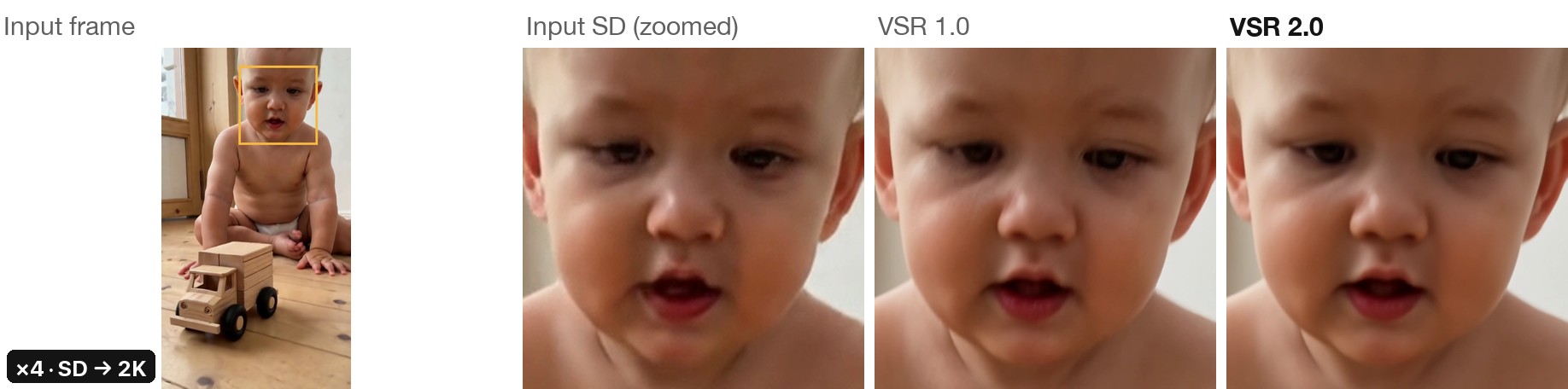
- More natural detail on hair, skin and fabric, without over-sharpened, “wiry” texture.
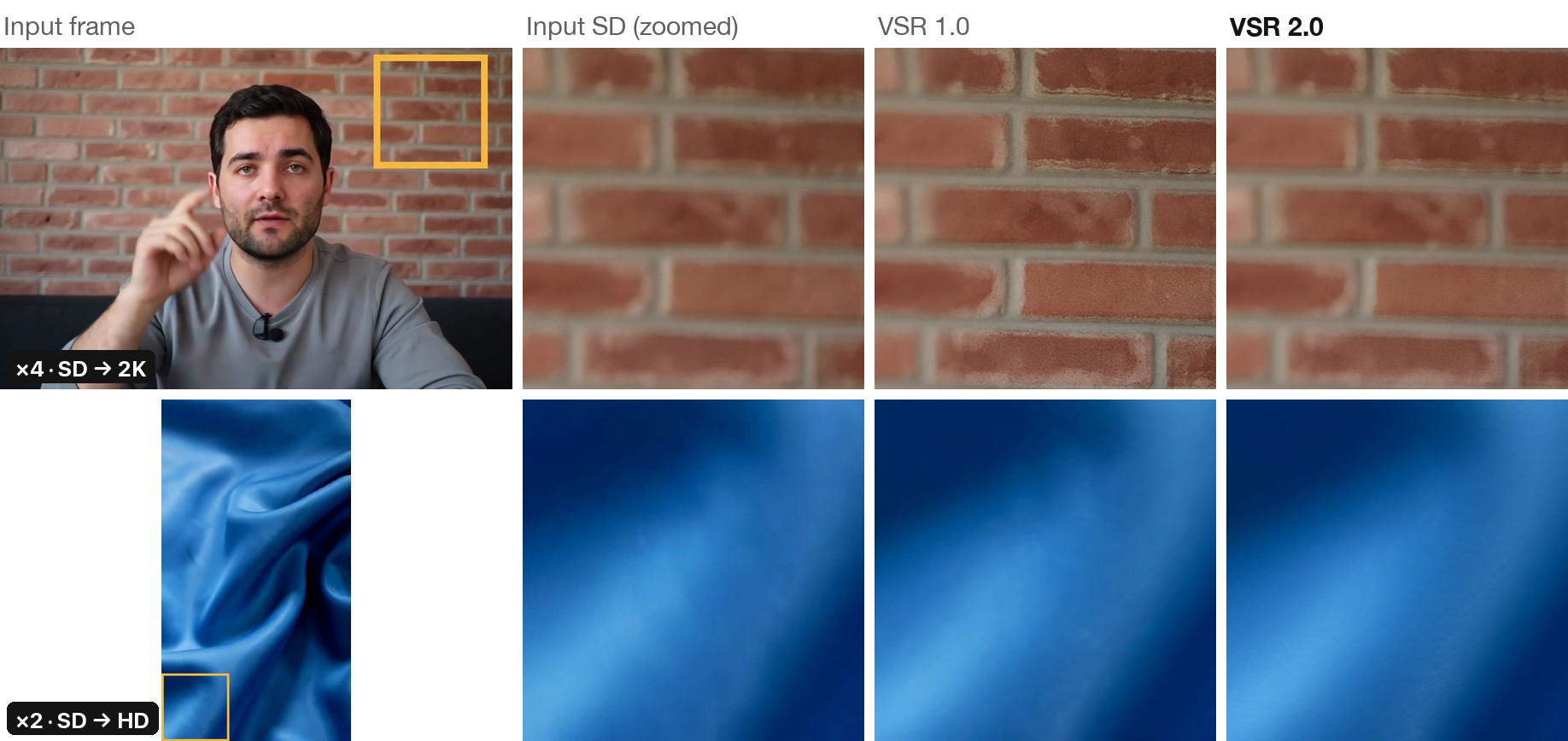
- Out-of-focus backgrounds stay out of focus, most visibly in ×4 mode (SD → 2K).
- Cleaner edges and stable detail in motion.
- Same speed: still two SR-DiT calls per tile.
- Drop-in upgrade: the same K-VAE, latent upscalers and pipeline; only the transformer weights change.
Where VSR 1.0 Fell Short
A super-resolution model has to decide, region by region, how much detail the output should have. VSR 1.0 tended to answer “more”. On a face in focus that is the right call; on a defocused wall or the trees behind a speaker, it turned soft bokeh into crisp, invented texture and flattened the depth of field. The effect was strongest in ×4 mode, where the model has the most room to add detail. A second, unrelated problem showed up in motion: edges came out rough, and fine features such as eyes or the contour of a chin could fall apart from frame to frame.
The two problems had different causes, so VSR 2.0 changes two different things: the training data and the final stage of distillation. The model was then trained again from scratch: every stage, from full attention through NABLA fine-tuning to π-Flow DX distillation, was rerun on the new data rather than fine-tuned from the VSR 1.0 checkpoint.
Training on Every Part of the Frame
Training clips are cut into tiles, and the way tiles are chosen decides what the model learns. Our crop selection deliberately favours the most informative regions: highly detailed areas and areas with motion. That is a good default for learning texture, but it also means the model almost never saw a tile of out-of-focus background. Asked to upscale one, it did what it had learned to do everywhere else and added detail.
For VSR 2.0 we collected an additional dataset in which tiles are sampled evenly across levels of detail, from sharp foreground texture to blurred backgrounds, and trained on it together with the existing data. The model now learns that a soft region of the input usually has to stay soft in the output, and smooth surfaces benefit as well.
Retuned Distillation
The rough edges came from elsewhere. VSR reaches two transformer calls per tile through π-Flow DX distillation, and its last stage sets how the few-step student trades sharpness against stability. For VSR 2.0 we searched this stage again and found a better set of hyperparameters: edges come out cleaner, and fine detail no longer breaks up when the subject moves. The new checkpoint also samples with a timestep shift of 5 instead of 3.5. The value ships in the model's scheduler config, so the pipelines pick it up automatically.
Comparison with Topaz Video AI
We compared VSR 2.0 with Topaz Video AI (Proteus model) in a blind side-by-side test at ×2 on two sets of clips: video produced by generative models and real footage. Each pair was rated by three people, and a clip counts as a win for the model that most of them preferred.
| Clips | Videos | VSR 2.0 preferred | Topaz preferred | Tie or no majority | VSR 2.0 win rate* |
|---|---|---|---|---|---|
| Generated | 48 | 46 | 0 | 2 | 100% |
| Real | 43 | 28 | 8 | 7 | 78% |
* Among clips with a clear majority. Both results are statistically significant (two-sided binomial test, p < 10−13 for generated clips and p = 0.001 for real footage).
On generated video, VSR 2.0 won every decisive comparison across people, animals, nature, architecture and objects. On real footage the margin is smaller but holds in every category, with the largest lead on organic and textured surfaces such as skin, hair, foliage and fabric (80%) and the smallest on objects (56%).
Same Architecture, New Weights
The architecture and inference are the same as in VSR 1.0: K-VAE encodes the clip once, the Latent Upscaler enlarges the latent by ×2 or ×4, SR-DiT restores 512 × 768 tiles in two calls with NABLA sparse attention, and overlapping tiles are blended with Hann windows. Speed and memory use are the same as before. Upgrading only means loading the new checkpoint:
import torch
from diffusers import Kandinsky6SRPipeline

pipe = Kandinsky6SRPipeline.from_pretrained(
    "kandinskylab/Kandinsky-6.0-VSR-2.0-distilled2steps-Diffusers", dtype=torch.bfloat16
)
output = pipe(video=video, resolution_scale=2.25, num_inference_steps=2)
The kandy-sr CLI and the ComfyUI nodes use VSR 2.0 by default, and vLLM-Omni, SGLang and FastVideo accept the new checkpoint as is. The code now also accepts clips of up to 15 seconds. The model weights, inference code and Diffusers integration are open-sourced under the MIT license.
Citation
@misc{kandinsky2026kandinsky60videofoundation,
title={Kandinsky 6.0 Video: Foundation Models for Synchronized Video and Audio Generation},
author={Team Kandinsky},
year={2026},
eprint={2610.05608},
archivePrefix={arXiv},
primaryClass={cs.CV},
url={https://arxiv.org/abs/2610.05608},
}