
Kandinsky Video Super Resolution 1.0: Two-Step Video Super-Resolution to Full HD and 2K
We are releasing Kandinsky Video Super Resolution 1.0, a video super-resolution model that upscales clips by ×2 or ×4 and restores fine detail such as hair, skin and fabric texture while keeping it stable from frame to frame. In the Kandinsky 6.0 Video pipeline, the base generator produces SD video and is responsible for the story, composition and motion; Video SR then takes the clip to Full HD or 2K. The model also runs on its own on any user video.
Video SR processes a clip as a set of spatial tiles, each covering the full duration of the clip, and restores every tile in just two transformer calls. No text prompt is needed, and the pipeline runs on consumer GPUs with 16 to 32 GB of memory.
Model Architecture and Inference
The pipeline has three components: the K-VAE video autoencoder, a Latent Upscaler and the SR-DiT diffusion transformer. K-VAE compresses video 16× in width and height and 4× in time into 64-channel latents, so a 121-frame clip becomes 31 latent frames. The input clip is encoded only once. The Latent Upscaler, initialized from the K-VAE decoder, then enlarges the latent by ×2 or ×4 directly in latent space, so tiles never have to be re-encoded from pixels. It has a separate branch for each factor: about 1.44B parameters for ×4 and a lighter 0.76B branch for ×2.
SR-DiT is based on Kandinsky 5.0 Video Lite: 32 transformer blocks with a hidden size of 1792, about 1.41B parameters, shared by both factors. Text conditioning is removed, since the content of the scene is already defined by the input video. Instead of starting from pure noise, the upscaled LQ latent is mixed with Gaussian noise, z̃LQ = √(1 − s²) · zLQ↑ + s · ε with s = 0.7, so the starting point already carries the structure of the clip. The distilled transformer with NABLA sparse attention restores each tile in two evaluations, and K-VAE decodes the result back to pixels.
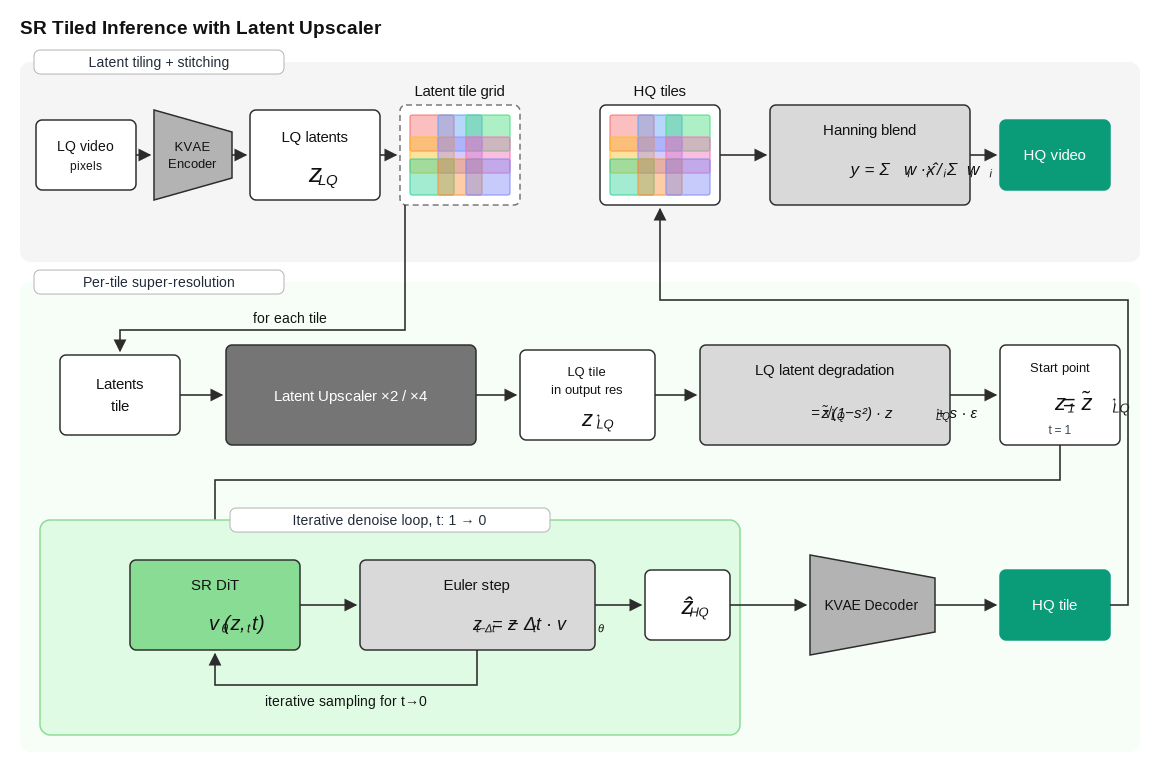
The transformer works on tiles of 512 × 768 pixels, or 512 × 512 for square video. Larger outputs are assembled from tiles that overlap by at least 25% and are blended with Hann-window weights, so no seams appear between them. Full HD output uses a combined ×2.25 route, a slight ×1.125 upscale in pixels followed by the ×2 mode, and 2K output uses the ×4 mode. On a single NVIDIA H100, a 5-second 864 × 480 clip is upscaled to Full HD in about 40 s and to 2K in about 131 s. With block-wise offloading and decoding in short segments, the same pipeline runs on GPUs with 16, 24 and 32 GB of memory and processes a Full HD clip on an RTX 5090 in about a minute and a half.
Training
The training set contains 150 thousand clips: 4K footage, high-resolution videos from the Kandinsky 5.0 T2V collection and synthetic camera moves over 4K photographs. Low-quality inputs come from two degradation pipelines. The first is a video version of Real-ESRGAN with blur, resizing, noise, JPEG and video compression, whose parameters are fixed for the whole clip. The second follows CreativeVR and imitates generation artifacts: time-varying geometric warps, motion blur, blending of neighboring frames, and dropped frames restored by interpolation.
SR-DiT is trained with flow matching between the noised LQ latent and the HQ latent. During training, the HQ latent of the first frame and its mask are added to the input as an anchor and dropped with a probability of 15%; the anchor is not used at inference, but training with it improves restoration. At low noise levels, the predicted clean latent is decoded by the frozen K-VAE and compared with the reference using an L1 loss on pixels, LPIPS and two frequency-domain losses that suppress grid-like artifacts. Training runs in three stages: full attention, fine-tuning with NABLA sparse attention, and π-Flow DX distillation down to two transformer calls per tile. The Latent Upscaler is trained separately with a Charbonnier loss on latents and an L1 loss on pixels decoded by the frozen K-VAE.
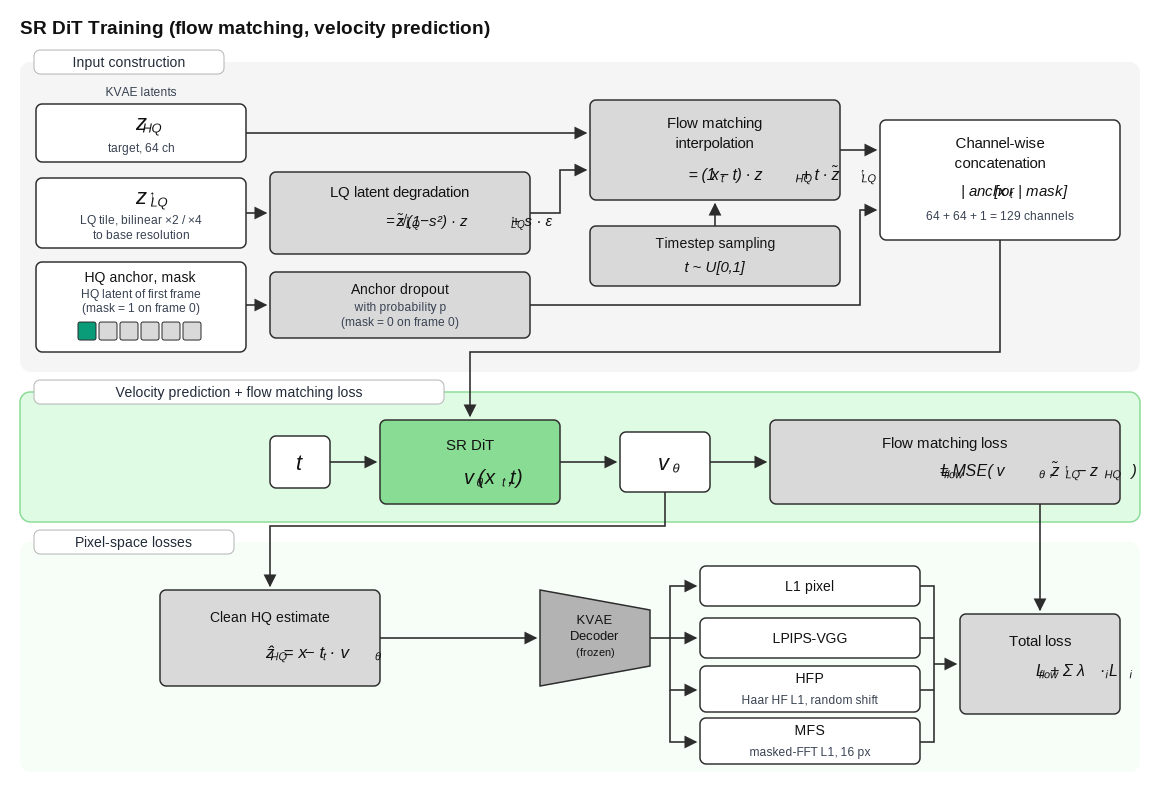
The model weights, inference code and Diffusers integration are open-sourced under the MIT license.
Citation
@misc{kandinsky2026kandinsky60videofoundation,
title={Kandinsky 6.0 Video: Foundation Models for Synchronized Video and Audio Generation},
author={Team Kandinsky},
year={2026},
eprint={2610.05608},
archivePrefix={arXiv},
primaryClass={cs.CV},
url={https://arxiv.org/abs/2610.05608},
}