
Kandinsky 6.0 Video: Create Video and Sound Together
We introduce Kandinsky 6.0 Video, the family of models for generating video and synchronized audio from text prompts, optionally guided by a reference image. We offer two versions — Lite (3B parameters) and Pro (29B) — that produce five-second clips with 44 kHz audio, speech and lip synchronization. We use a new two-stage generation pipeline that combines a base model with a super-resolution model to produce Full HD videos.
Data Filtering
Our training data:
We remove duplicates, watermarks, excessive text, scene cuts, unsuitable frame rates, and silent, corrupted or poor audio. We filter clips based on lip-sync and desync scores. For image conditioning, we check sharpness, exposure and action-starts; we use expert review for the supervised fine-tuning data.
Architecture
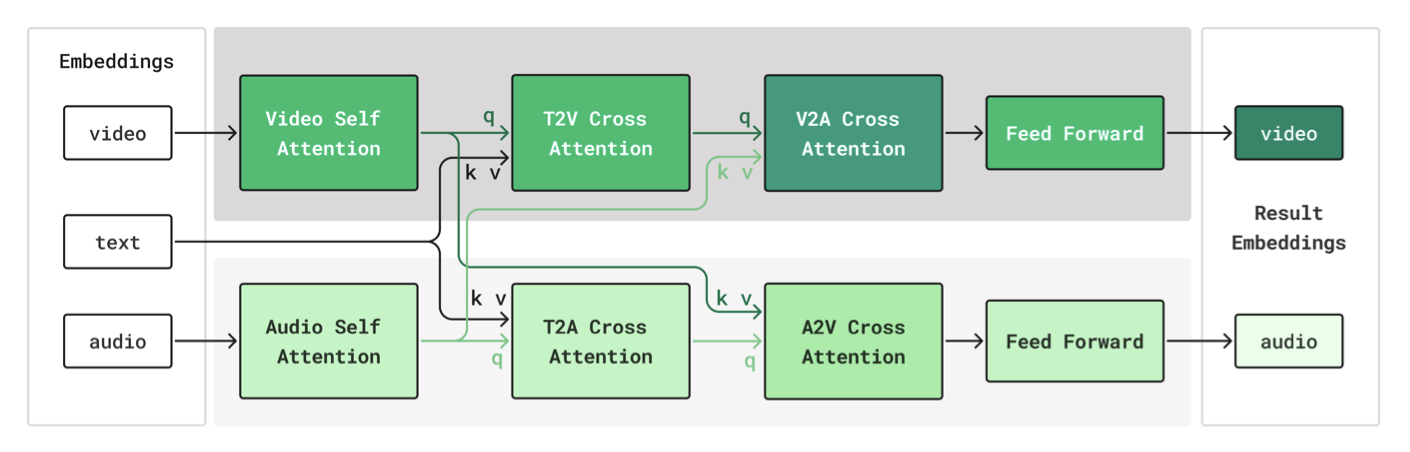
Our video and audio CrossDiT streams communicate through bidirectional cross-attention, with 3D/1D positional encoding respectively.
We divide the work across several components:
- Video and audio compression: We use a Hunyuan VAE to represent video in latent space and MMAudio components to encode audio and reconstruct its waveform.
- Text conditioning: We use Qwen2.5-VL for token-level text features and CLIP for a pooled representation of the prompt.
- Super-resolution: In the second stage, we process overlapping tiles in K-VAE latent space and blend them together. Our 2.25× scaling route produces Full HD output.
Training Pipeline
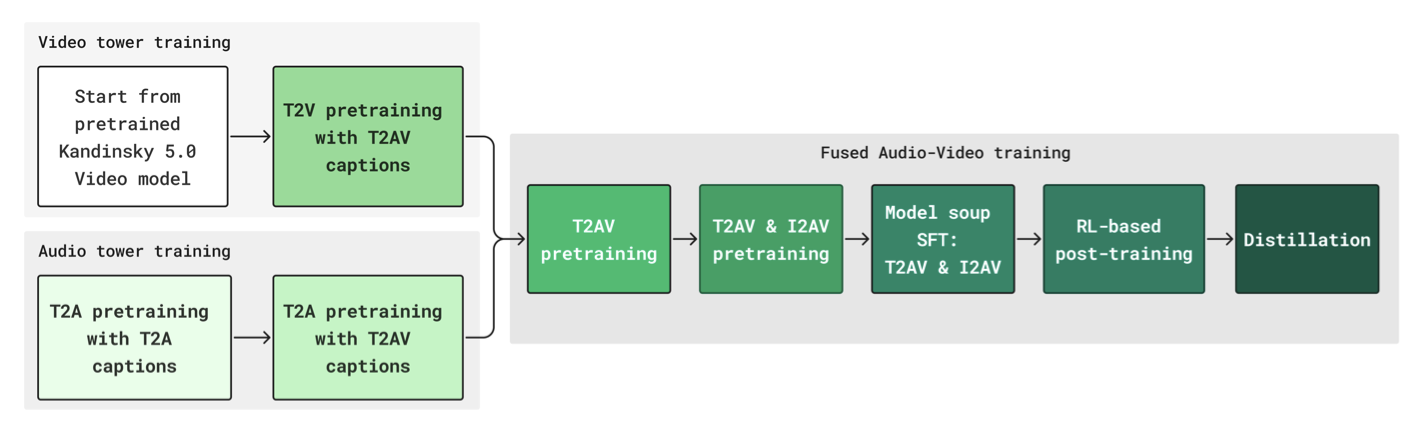
- Bootstrap and align. We initialize video from Kandinsky 5.0, pretrain audio separately, then train both streams jointly with flow matching.
- Supervised refinement. We fine-tune across 11 content domains in two stages, then combine specialist checkpoints through weight averaging, or model soup.
- Reinforcement learning. We apply OmniNFT-based post-training to improve speech intelligibility and audiovisual synchronization.
- Distillation. We use π-Flow to compress generation to 10 network evaluations, followed by Sim-LADD adversarial refinement to improve perceptual fidelity.
VABench results
We evaluate our Lite and Pro models on VABench, covering audio quality, synchronization, alignment, realism and expressiveness. In this comparison, our Pro model leads on seven metrics and Lite on four.
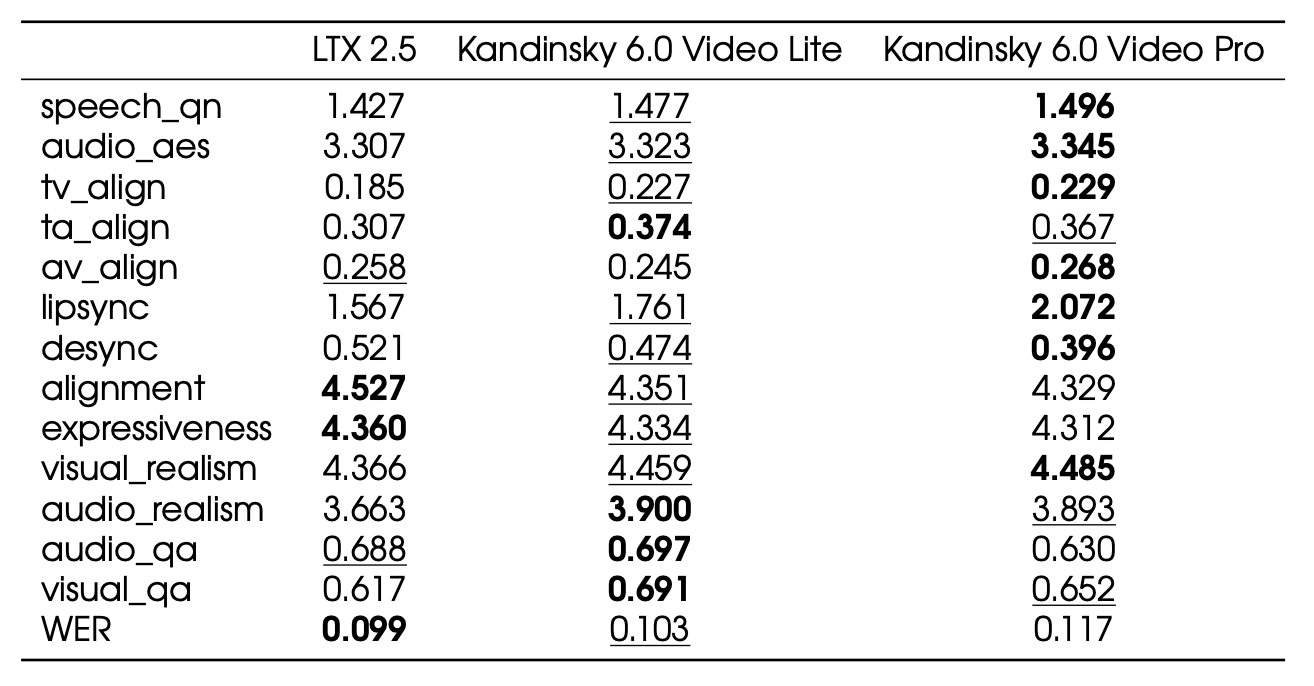
Our Pro model performs strongest in speech quality, synchronization and visual realism, while Lite leads in text–audio alignment, audio realism, and audio and visual quality scores. LTX 2.5 leads in VLM-judged alignment and expressiveness.
GPU Inference Performance
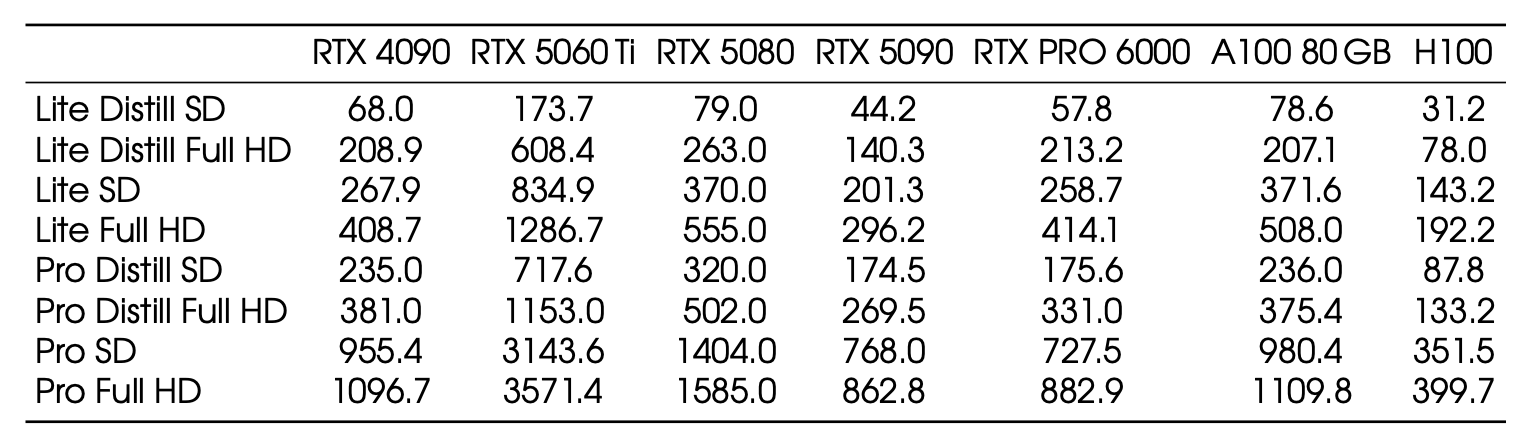
We report generation times for one five-second clip with audio. Each cell shows SD / Full HD, in seconds. We measure after warm-up and exclude weight loading and MP4 encoding. Full HD includes super-resolution.
Open Release
We release our code and model checkpoints under the MIT license, with Diffusers integration and separate standard, distilled and pretrained variants.
Citation
@misc{kandinsky2026kandinsky60videofoundation,
      title={Kandinsky 6.0 Video: Foundation Models for Synchronized Video and Audio Generation},
      author={Team Kandinsky and Julia Agafonova and Bulat Akhmatov and Mikhail Aksyutin and Grigorii Alekseenko and Anastasia Aliaskina and Olga Androsova and Vladimir Arkhipkin and Anna Averchenkova and Alexander Belykh and Serafima Bocharova and Sofiya Bogakovskaya and Anton Bukashkin and Mark Bulygin and Kirill Buzygin and Irina Cheremnykh and Kirill Chernyshev and Mikhail Chernyshov and Vladimir Chernyy and David Chikovani and Georgy Daniltsev and Denis Dimitrov and Anna Dmitrienko and Vladimir Dokholyan and Sergey Emelyanov and Dmitry Ermilov and Georgii Fedorov and Polina Gavrilova and Nikolai Gerasimenko and Aleksandr Gordeev and Andrey Inozemtsev and Andrei Ivaniuta and Alexander Ivanov and Mikhail Karaev and Anastasiia Kargapoltseva and Ivan Kirillov and Nikita Kiselev and Valeria Kobenko and Yury Kolabushin and Denis Koposov and Anatoly Korobov and Vladimir Korviakov and Maria Kovaleva and Kirill Kozlov and Denis Krzhivokolskiy and Konstantin Kuklev and Alexander Kunitsyn and Sergey Kuzin and Vladislav Lakhtionov and Alexey Letunovskiy and Maxim Litvinov and Alexander Lyulkov and Georgy Makarov and Kirill Malakhov and Egor Malykh and Mikhail Mamaev and Dmitrii Mikhailov and Polina Mikhailova and Ivan Mikheev and Elizaveta Muromtseva and Nikolai Nazarkin and Tatiana Nikulina and Lev Novitskiy and Stanislav Onuchin and Nikita Osterov and Denis Parkhomenko and Anatoliy Parpara and Vladimir Polovnikov and Konstantin Reznikov and Azat Saginbaev and Nikita Samsonov and Alexander Sentsov and Nikita Shaimov and Artem Sherstyuk and Andrey Shutkin and Egor Silvestrov and Bulat Suleimanov and Matvey Suprunov and Sergey Taranov and Irina Tolstykh and Tatiana Trofimuk and Ilya Trushkin and Aleksandra Tsybina and Olga Varlashina and Viacheslav Vasilev and Ilya Vasiliev and Eugeny Vilisov and Sergey Yakubson and Konstantin Zakharov},
      year={2026},
      eprint={2610.05608},
      archivePrefix={arXiv},
      primaryClass={cs.CV},
      url={https://arxiv.org/abs/2610.05608},
}